A Seat at the Table
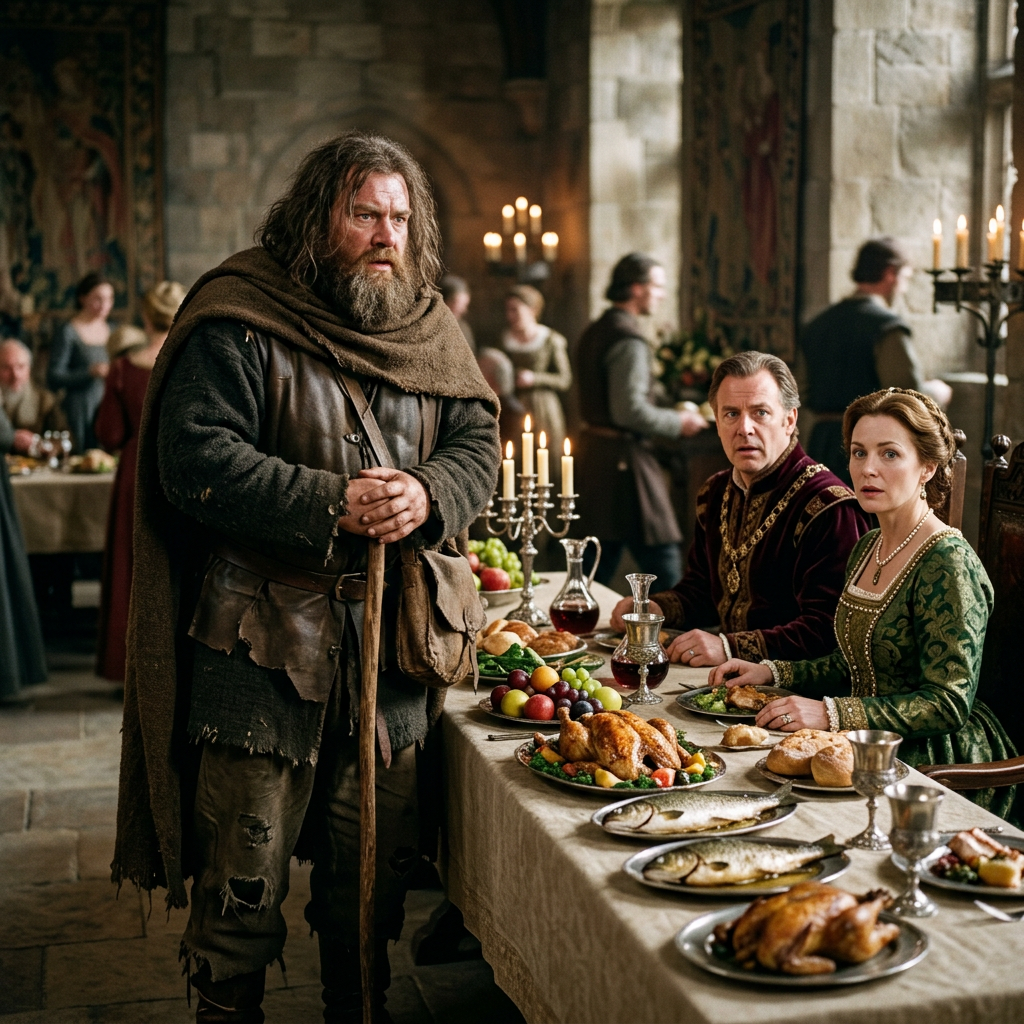
The man and the woman exchanged smug glances before turning toward the stranger.
He was a large man. A bushy gray beard hung well below his round belly, and his arms were thick as tree limbs. At first glance, he looked like the sort of man who could split logs with his bare hands and argue with a stone wall until it surrendered.
But appearances are often poor judges of character.
Though rough in appearance, the stranger was gentle in spirit.
The man and the woman had little desire to share their feast with such a traveler. Their table overflowed with roasted meat, fresh bread, and sweet fruit, yet neither felt inclined to spare a morsel.
The stranger, however, smiled at the sight of the meal.
“May you help a stranger in need, sir… madam?” he asked politely.
The man and the woman continued eating as though they had not heard him.
“May you help a stranger in need, sir… madam?” the stranger repeated.
The man glanced at the woman, then back at the traveler.
“May you help a stranger in need, sir… madam?”
This time the man set down his fork.
“What is your name, son?” he asked.
“My name is Rye, sir.”
“Rye, I’ve lived many years before you, and never once have I begged for food.”
“Your fortune has been kinder than mine, sir,” Rye replied. “I have had little luck.”
“Everyone has some measure of luck.”
“Not I, sir.”
“Surely you have a home. A wife. A trade. Children to feed.”
“I have none, sir.”
The man folded his arms.
“And what makes you think we should share our meal with you?”
“I am a hungry man,” Rye replied. “A starving man. The hand of generosity reaches farther than we often realize, sir.”
The woman slowly set aside her fork.
“Mister Rye, I was always taught not to speak with strangers.”
A faint smile crossed Rye’s face.
“I am no stranger now, madam. You know my name. My name is Rye.”
“We worked hard for this meal.”
“I do not doubt it.”
“Then why don’t you have a home?” she asked. “A wife? A trade? Children?”
Rye lowered his head slightly, as though carrying a memory too heavy to lift.
“I was once happy.”
“Once?” said the man. “Why not now?”
Rye’s head tilted downward slightly as though ashamed.
“I was once happy.”
“Once?” said the man. “Why not now?”
Rye was silent for a moment.
“Because I thought happiness was something I could keep,” he finally answered.
The man frowned.
“What does that mean?”
“It means I had a wife. I had a son. I had a home and work enough to fill my days. I thought those things belonged to me forever.”
The woman shifted in her seat.
“And what happened?”
“A fever came through our village one winter.”
Neither the man nor the woman spoke.
“It took my son first,” Rye continued. “Then my wife. After that, I no longer cared for the house. I no longer cared for the work. Eventually, I had neither.”
The table grew quiet.
The man looked down at the food spread before him. The roasted meat. The fresh bread. The steaming potatoes.
“And now?” he asked softly.
“Now I walk,” said Rye. “I walk where the road leads. Some days I find kindness. Some days I do not. Today I found your table.”
The woman’s eyes fell to her plate.
“You have truly eaten nothing?”
“Not since yesterday morning.”
The man glanced at the woman. The woman glanced at the man.
Without a word, she pulled an empty plate from the stack and set it before Rye.
The man tore a large piece of bread and placed it on the plate.
“Sit,” he said.
Rye smiled.
It was not the smile of a beggar receiving food.
It was the smile of a man receiving something far more valuable.
“Thank you,” he said.
The three ate together beneath the afternoon sun.
For a long while, nobody spoke.
At last Rye stood and brushed the crumbs from his beard.
“I have nothing to repay you with,” he said.
The man shook his head.
“You owe us nothing.”
Rye smiled again.
“Then perhaps I can leave you with this.”
“What is that?” asked the woman.
Rye looked at the feast still covering the table.
“A full stomach lasts a few hours,” he said. “But a generous heart can feed a man for the rest of his life.”
With that, he turned and continued down the road.
The man and the woman watched until he disappeared beyond the hill.
Neither touched the food that remained.
For the first time that day, they understood that the richest thing on the table had never been the meal.
The end.
To read more of my fiction work, click here.
Enjoying my writing?
If you’d like to support my writing and help me continue creating Bible-centered content, devotionals, and write my books, consider making a small donation via PayPal. Your partnership helps make this work possible, and I’m truly grateful for every subscriber and supporter who comes alongside this work.
Every gift helps expand the reach of biblical encouragement, my books’ readership, and gospel-centered content to people who need hope, truth, and the good news of Jesus. Thank you!